

Fluorescence-Guided Cryo-ET of Malaria Parasites
Correlative cryo workflow with cryo-planing and cryo-fluorescence imaging enables targeted cryo-ET of parasite-rich regions in complex tissue.

Cryo-ET Sample Preparation: From Waffle Method to Serial Lift-Out
Cryo-ET sample preparation becomes more demanding when specimens are thicker, larger, or more complex. This webinar brings together four perspectives on how high-pressure freezing can be connected…
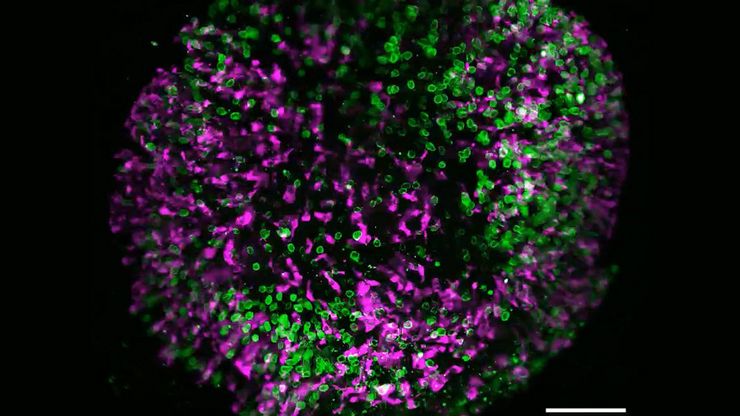
如何深入了解类器官和细胞球模型
在本电子书中,您将了解3D细胞培养模型(如类器官和细胞球)成像的关键注意事项。探索创新型显微镜解决方案,来实时记录类器官和细胞球的动态成像过程。

Waffle Method Workflow: From HPF to Cryo-ET Lamellae
Waffle freezing provides an HPF-based route to cryo-ET sample preparation. This workflow guide follows the process from grid and carrier assembly to vitrification, cryo-FIB milling, lamella…

Fast, High-Contrast Widefield Imaging of Optically Challenging Samples
Live‑cell imaging of large, complex biological samples often requires large fields of view, sub-cellular resolution, high-sensitivity, and fast acquisition – all while maintaining low illumination…

Spatial Proteomics Workflow in Blood Cancer (MPNs)
Megakaryocytes play a central role in the biology of myeloproliferative neoplasms (MPNs), yet their in vivo proteomic characterization remains a major challenge due to low abundance and disrupted…

Multiscale Imaging of Organoids: High Content to Light Sheet
Learn multiscale organoid imaging: fixed high content phenotyping, gentle dual view light sheet, and reproducible pipelines that turn 3D data into insights.

比例成像
细胞的许多基本功能在很大程度上依赖于离子(例如钙、镁)、电压势和细胞质与周围细胞外空间之间的 pH 值的微妙但动态的平衡。这些平衡的变化会显著改变细胞的行为和功能。因此,实时测量细胞内离子、电压和 pH…

荧光寿命成像与荧光共振能量转移
荧光寿命是荧光团在发射荧光光子返回基态之前保持其激发态的平均时间长度。这取决于荧光团的分子组成和纳米环境。
FLIM将寿命测量与成像相结合:对每个图像像素以测得的荧光寿命进行颜色编码,产生额外的图像反差。因此,FLIM可以提供关于荧光分子空间分布的信息和有关其生化状态或纳米环境的信息。…


